

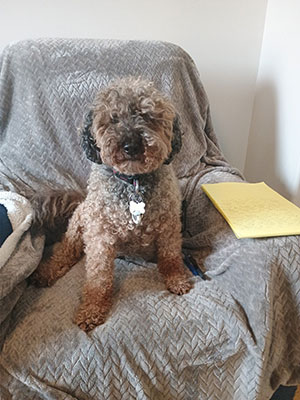
Zoey - the SDLaw Office Dog
One of the unique aspects of our Timmins law office is that we have a small goldendoodle named Zoey. If you ever come to our office, she likely will be one of the first individuals to greet you. She is well loved and spoiled. However, she is good with kids and being sensitive when someone is going through a stressful time.
Fortunately, the ownership of Zoey is not in any doubt. Suzanne Desrosiers purchased Zoey over 16 years ago, and for more than a decade Zoey has greeted clients and sat in on client consultations. However, dogs can become the subject of legal disputes when a relationship ends, and both parties believe they should keep the pet. One may assume that typical family law principles, like the best interest of the dog or shared parenting time would apply. This assumption is flawed and not supported by Ontario law, as demonstrated in Brooke-Bisschop v Carson (2026 ONSC 3945).
Brooke-Bisschop v Carson (2026 ONSC 3945)
Mr. Brooke-Bisschop and Ms. Carson were in a relationship where they purchased a dog named Cooper. Although both of their names appeared on the purchase documentation, Ms. Carson paid the cost for Cooper. During their relationship, the parties lived together for a period of time and jointly cared for Cooper, each paying for some of the expenses. Following the couple's separation, Cooper remained primarily in the care of Ms. Carson, although Mr. Brooke-Bisschop continued to spend time with the dog, especially as they were trying to repair their relationship, and maintained that the parties had intended to share ownership.
In court, Mr. Brooke-Bisschop claimed that Cooper was jointly owned and sought an order requiring the parties to continue sharing possession of the dog. In the alternative, he sought compensation for expenses he said that he incurred in caring for Cooper, which the judge understood as an unjust enrichment claim. Ms. Carson disputed those claims, maintaining that she alone purchased the dog, paid the purchase price, and intended to be Cooper's sole owner from the outset.
The court dismissed the plaintiff's claim and declared that Ms. Carson was the sole legal owner of Cooper. In doing so, the judge reiterated that while pets often hold immense emotional significance, Ontario law continues to treat dogs as personal property. As a result, the court's role was not to determine which party had the stronger emotional bond with the dog or would be the better owner, but rather to determine ownership using traditional principles of property law.
After reviewing the evidence, the court found that Ms. Carson paid the full purchase price, was the driving force behind acquiring Cooper, and assumed primary responsibility for Cooper's care. Although the parties both cared for Cooper during their relationship and occasionally referred to him as "our dog," the judge concluded that these were common features of a romantic relationship and were insufficient to establish joint ownership. The court also rejected Mr. Brooke-Bisschop’s claims for a shared possession arrangement and damages, finding that no enforceable agreement existed and that any expenditures made on the dog were voluntary contributions made during the relationship rather than expenses giving rise to compensation. The judge further expressed that even if there was such an agreement, a joint ownership arrangement is not something that the court can award.
Takeaways
This case is a reminder that there is no such thing as a "small" legal issue when something important, like a dog, is at stake. What began as a dispute over a dog eventually required the court to analyze competing evidence, assess witness credibility, and apply principles of property law, contract law, and unjust enrichment. The successful party was represented by counsel and was able to present evidence supporting ownership. By contrast, many of Mr. Brooke-Bisschop's claims were undermined by a lack of supporting evidence and misunderstandings about the legal principles governing pet ownership.
Many Small Claims Court matters involve similar issues. Clients are often surprised to learn how complicated and important documents, communications, and legal strategy can become once a dispute reaches the courtroom. Seeking legal advice early can help ensure that your case is built on solid evidence and a legal theory that will stand up to scrutiny if the matter proceeds before a judge.
How Suzanne Desrosiers Professional Corporation Can Help
At Suzanne Desrosiers Professional Corporation our lawyers have experience with matters going to Small Claims Court. We can help you at whatever stage your matter is at in the Small Claims Court process from the initial filings to making arguments in court. However, it is important to note that the Small Claims Court has tight deadlines, so it is advisable to contact one of our lawyers promptly if you need our assistance in such a matter. To speak to one of our lawyers, please call us at 705-268-6492 or email us at info@sdlawtimmins.com.